

As featured in HousingWire
My first HousingWire article, “Real Estate Brokerages Cannot Recruit Their Way Out of a Training Problem,” was published October 23, 2026.
Real estate has been part of my life for as long as I can remember.
I grew up around my parents' real estate brokerage and began working in the industry in 2008. I earned my real estate license at 18 and became a broker at 22, but some of the most valuable lessons I've learned about this business came long before I ever sat in a licensing classroom. I watched my parents build and operate a brokerage that grew to approximately 700 agents before it was acquired in 2019. And when you're responsible for that many agents, you learn pretty quickly that running a brokerage involves a whole lot more than recruiting people and closing transactions.
My late father, Chris, and my mom, Cindy, took their responsibilities seriously. They believed in doing things the right way, even when it wasn't the easiest or most convenient option.
Were there complaints over the years? Of course. When you're managing hundreds of independent contractors and thousands of transactions, challenges are inevitable. But what always stood out to me was how my parents handled those situations. They didn't believe in ignoring problems or sweeping things under the rug. Concerns were addressed, and when an agent's conduct warranted corrective action, they took it. Maintaining the brokerage's reputation and protecting the people who trusted them mattered more than simply keeping another agent on the roster.
I didn't realize it at the time, but watching them lead taught me a great deal about supervision, accountability and what it actually means to be responsible for other people's professional conduct.
And those lessons have stayed with me.
Why Brokerage Training Is Personal to Me
Today, as School Director of Tristar Academy, I see the industry from a different perspective. At Tristar, we've spent years teaching people who are just entering real estate, as well as experienced agents who have been practicing for decades. And one of the things we've always found interesting is how much you can learn from the questions people ask in class.
Sometimes it's a new student trying to understand a concept for the first time. Other times, it's an experienced agent asking about something they've been doing for years but were never properly taught. I've heard "Well, I've always done it this way" more times than I can count. And if you've ever taken one of my classes, you probably know that answer isn't going to get very far with me. Lol! Just because you've been doing something a certain way for years doesn't necessarily mean it's the right way to do it.
But we don't think the responsibility falls entirely on the agent. If someone has been practicing real estate for years without understanding a basic procedure, we have to ask what kind of training, supervision and support they've received along the way.
That question is what led me to write my first article for HousingWire, "Real Estate Brokerages Cannot Recruit Their Way Out of a Training Problem." And seeing it published on October 23, 2026, was a pretty exciting moment for me.
Recruiting Agents and Developing Agents Are Two Different Things
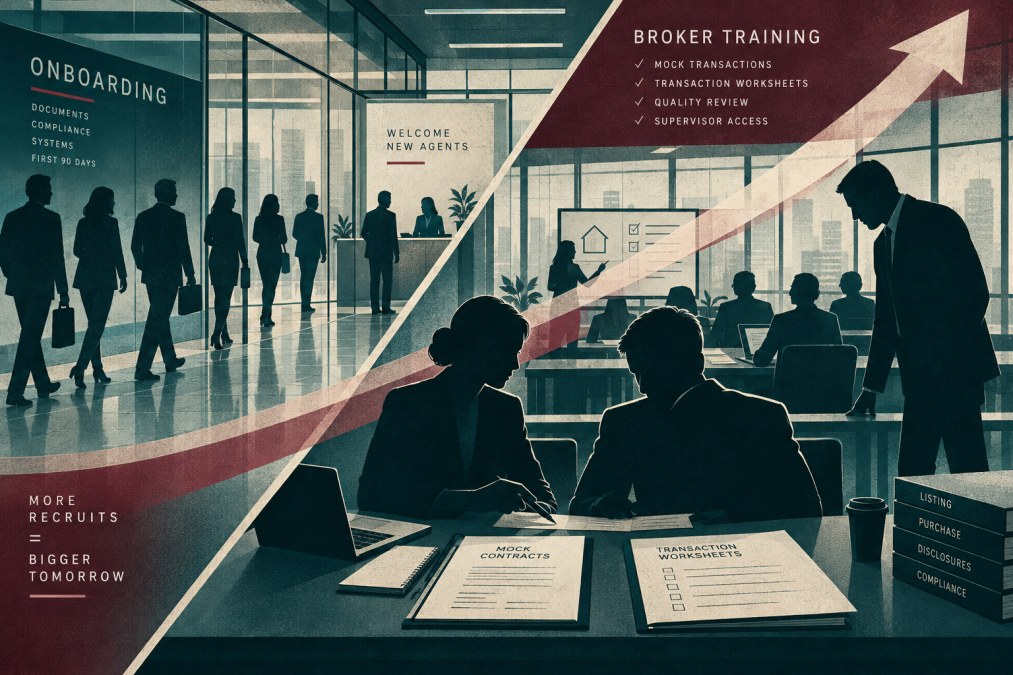
We understand why brokerages focus on recruitment. Agents are an important part of growing a real estate business, and finding the right brokerage can make a tremendous difference in an agent's career.
But I've also seen what it takes to manage a large organization.
Adding more agents doesn't automatically mean you're building a stronger brokerage.
What happens after someone joins?
Are they learning the company's procedures? Do they know how to handle common transaction issues? Are they comfortable reaching out to their broker when something doesn't seem right? And perhaps most importantly, is their broker actually accessible when they need guidance?
Those are the things that matter when we're talking about building a brokerage that can grow responsibly. My parents understood that having hundreds of agents meant having hundreds of individuals whose actions could affect the brokerage, its clients and its reputation. That level of responsibility requires more than an onboarding packet and a welcome meeting.
It requires ongoing education, clear expectations, proper supervision and the willingness to address problems when they arise.
Education Doesn't Stop When You Pass an Exam
At Tristar Academy, I get to celebrate a lot of milestones with our students. There's nothing quite like hearing that someone passed their licensing exam, especially when you know how hard they worked to get there. But passing an exam doesn't mean someone suddenly knows how to navigate every situation they'll encounter in a real estate transaction.
That's not a criticism of licensing education. It's an acknowledgment that learning the foundations of a profession and gaining practical experience are two different parts of becoming a competent professional. Real estate schools have a responsibility to provide that foundation. Brokerages have a responsibility to train and supervise their agents. And agents have a responsibility to continue learning and asking questions.
We believe all three have to work together.
It's also why we care about continuing education and professional development just as much as prelicensing education. Our classrooms aren't just for people trying to get into the industry. They're also for people who have been in it for years and recognize that there's always something new to learn.
And we think that's a good thing!
Continuing What My Parents Started
My parents built Tristar Academy around the belief that education could create opportunities for people. My dad was passionate about seeing others succeed, and my mom has continued to be an important part of carrying that vision forward. Today, she and I are still building together.
Our goals for Tristar Academy have grown over the years, but we don't want to lose sight of the principles that made our family businesses what they were. We want to provide education that people can actually use. We want our students to feel comfortable asking questions. We want experienced professionals to recognize that learning doesn't end just because they've been licensed for 10, 20 or even 30 years. And we want Tristar Academy to contribute to conversations that can make our industry better.
That's part of what made writing for HousingWire so meaningful to me!
For years, I've shared my thoughts in classrooms, through conversations with students, and with the agents and brokers I've worked alongside. Having the opportunity to share that perspective with a broader industry audience is something I'm genuinely proud of. But we also know that one article isn't going to solve the challenges facing real estate education or brokerage training.
It's a conversation worth continuing.
Let's Keep the Conversation Going
We hope brokerage owners, managers, instructors and agents take a few minutes to read the HousingWire article.
Not because we think every brokerage should operate exactly the way my parents did, but because we believe we can all benefit from taking a closer look at how we prepare, support and develop real estate professionals. The industry has changed vastly since I first started in 2008, and it will continue to change.
But the importance of education, accountability and doing right by the people who trust us shouldn't.
Read the full article on HousingWire
Real Estate Brokerages Cannot Recruit Their Way Out of a Training Problem
Thank you to everyone who has been part of our journey. I'm proud of what my parents built, grateful that my mom and I get to continue it, and excited about where we're taking Tristar Academy next.
About the author
Sarah Sinanan is the School Director and Education Coordinator at Tristar Academy and a real estate broker licensed in Maryland and Pennsylvania. She has worked in the real estate industry since 2008 and teaches licensing education, continuing education and professional development.
Training for your brokerage or team? Email [email protected]